Three days later, after the morning’s first sip of coffee, Erlon found he could no longer keep it inside. “I need to tell you something,” he said, catching his wife’s eye. And he told her. All of it. The missing pixel, the dreams, the Carolina bays. And the acorn.
Then, without asking a single clarifying question, she put her own coffee down and said, “I need to tell you something, too.”
And she told him. Everything. Visiting Oscar, the photo of the photo on her phone, Keturah. Tannile’s voice in the bathroom, the scent of lilies that reminded her of her anger.
There was a long silence. Erlon had known it would sound strange, talking about what had happened to him. He wasn’t prepared for this, though: his wife’s words sounding as strange as his own. His eyes widened, looking her over. It felt as if he were seeing her for the first time in a very long while.
Each of them met each other’s gaze, searched each other’s eyes, uncertain. He wanted to speak, had hoped that by telling her all of it, they would somehow find their way back to the way things used to be. But they couldn’t. This was something new.
Before, when words had failed him, he had always turned inward. But that had only brought him here, through all his trials, to this new place. Instead he strove to stay present in this strange endless moment that was breaking open even now like a scab, painful and raw.
“Are you angry with me?” Anette said at last.
His eyes widened. “Angry?” his voice sounded rough even in his own ears. “Why would I be?”
“She’s your sister. And I went behind your back.”
He smiled. “She’s my sister, yeah. But you know, she wasn’t mine. Can I see the photo you took?”
Anette passed her phone to him. He took it and righted it.
There she was. He had spent decades avoiding this sight, fleeing the pain that came with seeing her face—and yet here she was all the same. His avoidance had made her no less dead, no less herself. She was clear and evident even through the age of the image, the buffer of a digital screen. Her bright eyes, the smile more implied than evident on her lips. She seemed to be holding back her mirth, laughing privately at some secret all her own.
He could see how Anette might see anger, but he couldn’t. Tannile had been angry, certainly, in her moments, but here was something different. Something subtler. It made him feel he knew her as much as he ever had—both the wealth and poverty of such knowledge.
“What was it about her?” he asked. “That meant so much to you? That drew you to her?”
Anette’s eyes went soft, distant. “Maybe…she felt familiar. Like an echo of me—or maybe I was an echo of her. But so different at the same time… I don’t know. Maybe something of her was calling out to wake me up.”
Erlon nodded. He wasn’t sure he understood, so he filed it away to think about in the coming days.
Anette cut her eyes back to him. “And you,” she said. “Did you really think there was something missing in yourself?”
His cheeks warmed. “Yes,” he made himself say.
Her eyes deepened, the lines around them crinkling. He looked away.
“Did you find it?”
He sipped his coffee. He knew what he wanted to say, but felt reluctant to speak it. As if saying the words aloud would make it less real.
Still, he said, “There was nothing to find.” His voice was soft, warm, and a little sad.
Anette searched his eyes and he let her, not looking away. He touched her hand on the table with his fingertips. “What are you going to do now?” he asked. “Now that you’ve got your anger back?”
She leaned forward. “I’m not sure I have got it back. Not entirely. But that’s okay. It doesn’t have to be all at once.” She tilted her head conspiratorially. “There’s so much to do.”
Erlon smiled. “I know that’s right.”
“What about you, baby?” she asked. “What are you going to do, now that you’ve got your wholeness back?”
He thought a moment. How different this was, talking with Anette about such things. What he’d gone through, what they’d both gone through, had changed them. Made the two of them—the them that was separate from each as an individual—a different thing than they had been before. It scared him, but it was also freeing in a way. Things felt fresh, new, brimming with potential.
“I don’t know,” he said at last. “And…I kind of like the not knowing.” They both smiled. Then Erlon’s smile faded.
“But,” he said in a halting voice. “There is one thing. One thing I know I got to put right.”
* * *
It was the first time, Erlon mused as he cut off the gas and sat still for a moment in his car, that he had visited the diner since childhood. He tried to remember why he had come here then, all the way off the island, miles down Sixty-one at the west end of town. Had he been visiting his sister? Looking for her? Erlon could not remember.
Even before spotting the cop car in the lot, he found his pulse quickening. His hands avoided his pockets and he whistled a tune from a children’s movie, his gaze downward. Opening the diner’s glass door his eye caught a pale old man look up from a banquette, eyes narrowing. He tried to look safe and boring.
He took a seat at the bar and smiled at the young woman behind the counter. “Hi there,” she greeted him. “What can I get you?”
Erlon frowned, glancing at the laminated menu she slid in front of him. “What’s your cook’s specialty?” he asked, unable to keep the note of challenge from his voice.
“Well, folks love the fried chicken, but I’m real fond of his oxtail stew.”
“No chicken,” he said in a clipped voice. Erlon made himself relax a little. He caught the girl’s eye and smiled. “I’ll have the stew.”
The cortisol rush lowered in his veins as she left, leaving him alone. He looked around, took in the diner’s atmosphere. Dusty wood paneling, dim light streaming in through blinds. The tacky wall art and age-yellowed magazine clippings. There were few people here, and from the blank look on the employees’ faces he could see, it seemed the slow state of things was normal.
It hadn’t always been like this. The old Redfish Diner, even he knew, had once been an institution. There had been a time when folks from the peninsula would drive all the way out here to eat. The place had been in a magazine writeup decades ago, long before the city’s culinary revival, long before it lost most of its name. It’d been a rave review, sending flock after flock of proto-foodies its way, only cementing the place’s status as an institution.
Now things were different. The city was a center of regional food culture, and no magazine now, nor any publication worth its salt, would be interested in Ed’s Diner, diminished as it was to a mere dive. It would never achieve that sort of publicity again, but it didn’t have to. It was content to rest on its laurels—a strategy that seemed to have worked well enough to keep it open.
Erlon tried to see the place through Shem’s eyes. Was it comforting, the familiarity? Was he punishing himself by staying in this job? He realized he knew so very little about the man he’d spent decades blaming.
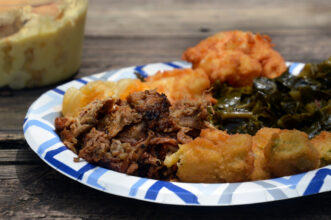
The bowl of stew came out soon enough, steaming and spicy, a mess of meat scattered with butter beans, onion, and allspice berries, carrots, and potato, all piled on white rice. It smelled delicious—like his grandmother’s kitchen, bringing back memories he wasn’t prepared for. Erlon took a bite and closed his eyes, the strong flavors yielding a rich burst of pleasure.
“Glad you like it,” a rough, dry voice spoke. He opened his eyes to see the cook smirk at him, hunched forward with hands on the counter.
Erlon swallowed and nearly choked. He reached for his glass of tea. “Shem,” he said at last.
“Early Bird.”
“I, uh—” he wiped his fingers on the napkin, “I came to see you.”
“That so?” Shem squinted, but the effect wasn’t unfriendly. “Man…it’s been a good minute, ain’t it? Don’t think I ever seen you up this way. You know I met your boy, about a year ago. He came in with a girl.”
“He…he did?” Erlon listened to the man’s swift, buoyant accent, the old island patois. The longer he sat in Shem’s aura, the more he found himself return to the same speech, the familiar rise and fall, the shapes the words made familiar again in his mouth.
“I’m guessing that’s news to you,” Shem smirked again.
Erlon frowned. “Yeah, it is, but—” He cleared his throat. “I—Listen, man. There’s—I want to…” He closed his eyes, wondering why this was so much harder than he’d thought. “I, uh, I guess I want to…to make things right. Between us.”
Shem’s brow lifted. He rubbed the wrist of his smaller hand, holding it to his chest, looking wary for the first time. “Okay,” he said.
Erlon looked him over, avoiding the man’s eyes. He paused to consider his next words. This wasn’t going how he’d thought; no conflict, antagonism. No resentment. He had imagined himself as the better man, forgiving Shem, perhaps accepting that Shem could not—would not—forgive him. But Shem, it seemed, already had; or perhaps had never held anything over Erlon’s head at all.
“Listen,” he said again, less certain. “I—I’m not proud of it, but…I hated you, man. For years. I…blamed you. For Tannile…for taking her away. But…I’ve been seeing things different lately. I see—I know—” He spread his hands palms up and finally looked the other man in the eye. “I know we both lost her.”
Shem didn’t speak. He looked closed off now, his eyes blank walls. But now that Erlon had started he had to push on to the end.
“And…the part of her you lost, maybe that…well, it was a side of her I never knew. And I think I blamed you for that, too. But none of that is right.”
Shem’s hands were in fists now, both trembling. Now it was he who couldn’t meet Erlon’s eyes. Had coming here been a mistake? Were his words only dredging up old wounds, long ago healed and scarred over?
“I didn’t understand,” he finished, nearly whispering.
Shem glanced at him at last. Erlon saw a familiar flash in his eyes, a bit of the younger man he knew from the island. A long time passed before Shem nodded. Swallowed.
“You didn’t understand a lot of things,” he said.
“That’s true.”
“But then…you understood a lot more than I ever gave you credit for.”
Erlon breathed, a ragged exhale spilling from dry lips. It felt as if the years between now and his memories of Tannile were mere illusion—that they were young men still, foolish and naive. Did Shem feel that way, too? He had the sensation of the two bleeding into each other, their edges blurring till he couldn’t tell where one of them ended and the other began. A new hole was opening inside Erlon, pixel thin. But it was different this time. It wasn’t empty. Grief poured out through it now like a spring.
Shem reached for the nearest bottle of dark rum and poured a portion for each into smudged glasses. “Tannile,” he said, voice thick.
They both drank.